
The Push-Pull Phenomenon — Why Your AuDHD Brain Can’t "Just Rest.”
The Regulate Series, Part 3

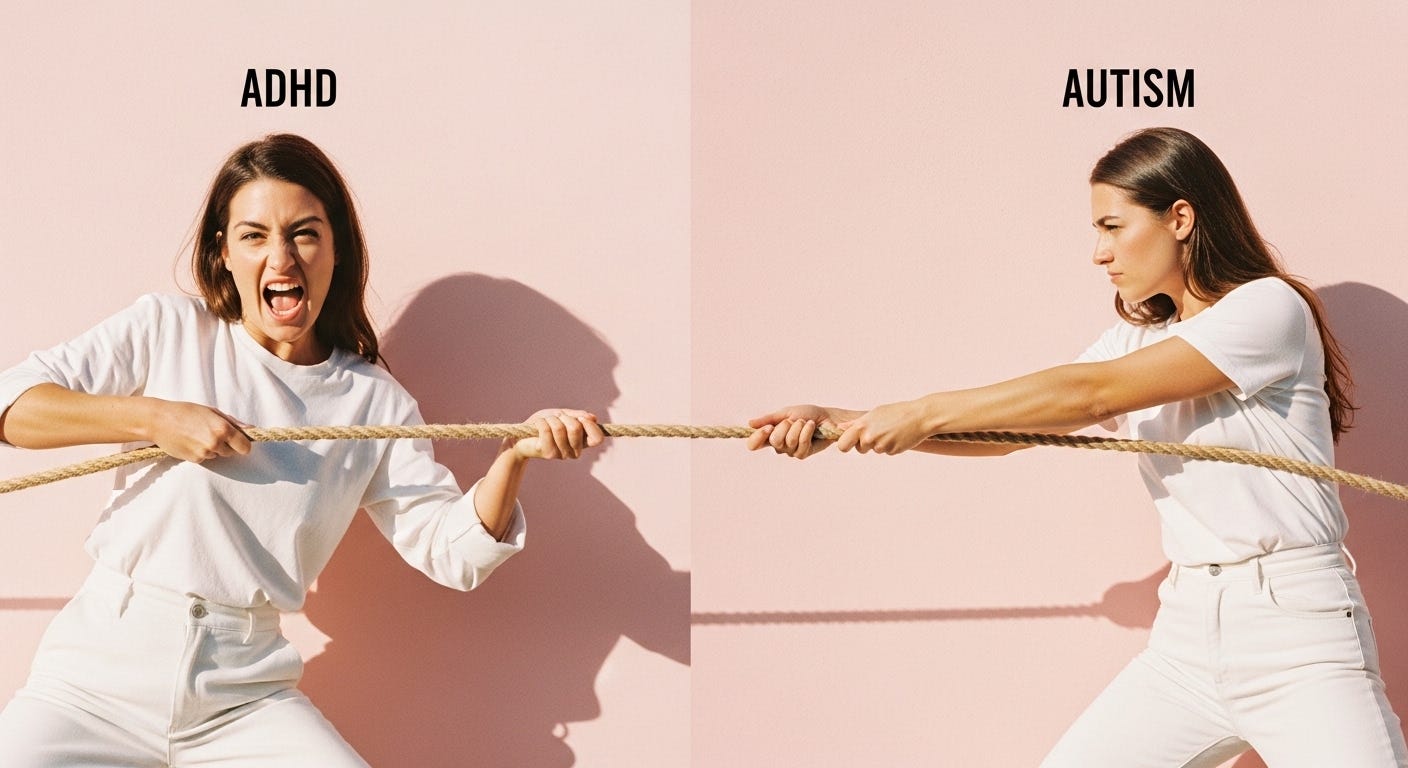
You know the one.
You’ve cancelled everything. Cleared the day. Told yourself, and genuinely meant it, that today we’re just going to rest. No plans, no output, no performing. Just me, the cat, the couch, The Hunger Games, a large packet of salty potato chips all to myself, and the complete absence of demands.
Autism is stoked with this plan. Ahhh, finally. Comfort day!
And then approximately ten minutes later we’re reorganising the bookshelf, googling flights somewhere we’re not going, or seventeen tabs deep into a hyperfixation about “how to make money online as a disabled person with the attention span of a flea” and launching our next 24 hour business idea. I swear this is it. This IS the next big thing. THIS is my MISSION now.
Aaand… ADHD has entered the building…
Then an advertisement for foam rollers appears. Thirty minutes later we’ve spent $100 on a giant piece of foam that is going to literally make EVERYTHING better finally.
What business idea? Gone. Forgotten.
Every single one of those things felt completely necessary and vitally important in the moment.
By the afternoon it’s all forgotten and we’re eating a take-out burger for dinner we couldn’t afford (but cooking is hard) going: omg I achieved nothing today. This burger was expensive I should have cooked the chicken. Oh wait, today was meant to be a day of nothing. I’m burnt out. I didn’t even rest. The burger is fine. But I haven’t rested. But I’m more tired than when I started. I didn’t actually achieve anything today. Omg. Wtf. Who am I even.
Enter…. Shelly Shame Spiral!
Spiral. Spiral. Spiral.
Oof. Rest days. Okay, sooo.. how do we actually do them when our colourful AuDHD nervous system has 50 different tabs open and 50 different needs and 50 new ideas and 50 opposing opinions about said ideas?
Welcome to Part 3 of The Regulate Series.
We’ve been working through what nervous system regulation actually looks like for AuDHD brains — not the meditation app version, the real one. Part 1 was about why our nervous systems get stuck in survival mode. Part 2 was about why the wellness industry’s solutions so often make things worse. This one goes underneath both of those.
The push-pull phenomenon.
What We Mean By Push-Pull
Here's the thing about AuDHD nervous systems that almost nothing in the wellness space — or the medical system that treats our autism and ADHD and chronic illness as separate problems to be managed in separate rooms — accounts for: we're not one thing.
Autistic nervous systems tend to need predictability to feel safe. Routine, sameness, knowing what’s coming — these aren’t personality quirks or rigidity, they’re genuine regulation tools. Predictability tells our nervous system the threat has passed. It can exhale.
ADHD nervous systems run on novelty. New input, new stimulus, the hit of something unexpected — dopamine isn’t just motivating for ADHD brains, it’s regulating. Routine, for an ADHD nervous system, can tip quickly into flatness. And flatness, for a nervous system already prone to dysregulation, isn’t neutral. It’s destabilising.
Both of these are real.
Both of these are ours.
At the same time, in the same body.
So when we try to rest — really rest, the kind where nothing new is happening and the environment is predictable and the demands have been removed — the autistic part of our nervous system starts to settle. Good. That’s working. And then the ADHD part registers the quiet and starts looking for the exit. Also working, completely as designed, completely unhelpful right now.
We’re being pulled in two directions by two nervous systems that both think they’re helping.
Neither of them is wrong. That’s the genuinely exhausting part.
Why Shutdown Isn’t the Same as Restoration
There’s a distinction I want to name here, and it changes how we understand what’s actually happening when we “crash.”
Shutdown — in the acute sense — is something many autistic people know viscerally. It arrives fast. The lights go out behind the eyes. Language becomes difficult or impossible. The body wants to be still, small, somewhere quiet and dark. It’s not chosen. It’s the nervous system pulling the emergency brake because the input has exceeded what it can process.
And then there’s the longer, slower state. The one that can last days, weeks, sometimes much longer. Dorsal vagal activation — the most ancient branch of our autonomic nervous system, sometimes called the freeze or collapse state — looks from the outside like profound rest. We’re horizontal. Quiet. Not responding to much. To anyone watching, we appear to be resting.
We’re not resting.
In dorsal vagal, our nervous system has gone offline to protect us. Digestion slows. Heart rate drops. The thinking brain becomes foggy or unreachable. Emotions flatten. The not-quite-here feeling, the sense of watching our life from slightly outside it — that’s dorsal vagal. And it’s not restoration, because the system isn’t recovering. It’s conserving. There’s a difference.
Shutdown — whether acute or prolonged — doesn’t restore capacity. It pauses depletion. We come out of it still depleted, sometimes more so, because existing in that collapsed state has its own cost. The body was working hard the whole time to do nothing.
Rest that actually restores requires our nervous system to shift into genuine parasympathetic recovery. The social engagement system coming back online. The body sensing safety rather than just stillness. And that shift doesn’t happen just because we stopped moving. It happens when our body gets actual evidence the threat has passed.
That’s a much harder thing to manufacture than lying down.
The Restless Rest Problem
Here’s where the push-pull really shows its teeth in daily life.
Our capacity is low. Sensory tolerance is thin. Executive function has quietly left the building. All signs point to: stop, do less, recover.
So we stop. And immediately the ADHD nervous system, now under-stimulated, starts generating its own noise. The intrusive thoughts. The mental to-do lists. The sudden overwhelming need to reorganise something, or text someone, or find out exactly how deep the Mariana Trench is and whether anything actually lives down there. (Things do. They’re absolutely fascinating. And disturbing. This was not a calming rabbit hole lol. but it did inspire some interesting drawings!)
We’re resting. We’re also, neurologically, completely activated.
And because we can’t act on any of it — because we know we need to rest, we’re trying to rest — the activation has nowhere to go. So it just runs. In the background. Like seventeen tabs we can’t close.
Stillness without actual nervous system shift isn’t rest. For AuDHD brains it can be genuinely agitating. The absence of external stimulation doesn’t switch off internal stimulation.
It usually turns up the volume on it.
The Novelty Trap
Something I’ve noticed in myself — and heard echoed enough times in this community that I know it’s not just me — is that novelty can feel genuinely regulating.
A new interest, a new project, the electric aliveness of something that hasn’t had time to become routine yet. For ADHD nervous systems especially, this isn’t just exciting. The dopamine hit is real, the state shift is real, and for a window of time it can feel like we’ve finally landed somewhere.
And there’s a reason for that. Dopamine generated through novelty is genuinely regulating for ADHD brains — not metaphorically, physiologically. It’s why dopamine dressing works. It’s why ADHD dopamine mashup playlists exist on Spotify. It’s why a new notebook or a spontaneous rearrangement of the furniture can shift your nervous system state in a way that a meditation app simply cannot. The brain gets what it needs and the system settles, at least for a while.
And then the novelty wears off.
Which it always does.
And we’re back where we started, except now there’s also an unfinished project, a new thing on the pile, and a nervous system that’s quietly learned to chase newness as a regulation strategy. Which works, until it doesn’t, and then we need more novelty to regulate from the come-down of the last lot of novelty.
I say this with full recognition that I have done this. Many times. With varying degrees of financial and emotional consequences.
And also — and I mean this — with a life that looks like absolutely nothing a neurotypical brain would have built.
I flew planes. Actual planes. In the sky. For a year. I look back at that now and genuinely think but how. And alongside that there are the certifications, the trainings, the whole careers, the communities built and dismantled and rebuilt somewhere new, the breadth of experience that came directly from a nervous system that needed to keep moving and found something real in every direction it turned.
The negative self-talk I carried about not being able to follow through was with me for a long time. It took identification, and real work in therapy, to start seeing it differently. Not to pretend the unfinished projects don’t exist. But to hold them alongside everything else. To see that the same neurology that left seventeen tabs open also said yes to things most people never attempt, because the aliveness of a new thing was too compelling to resist.
A neurotypical brain would have done one of those things really well. I did seventeen of them, for a short time, with my whole heart.
Is it chaotic? Yes. Has it cost me? Also yes. Would I trade it in for a one-size-fits-all life. Abso-fucking-lutely not.
I used to see my chaotic life choices as moral failing. Now I see them as a pattern. I also now see both the gifts and consequences of this pattern. And once we can see this as a pattern, we can start asking better questions about it. With curiously, compassion, and love.
Which is kind of the whole point of this publication ;)
So Here’s the Reframe.
We’ve spent a lot of time in this article — and honestly, probably a lot of time in our lives — trying to answer the question: how can I get more rest?
And maybe that’s not the right question.
Because for AuDHD nervous systems, “rest” carries a set of assumptions baked into it. That it looks like stillness. That it means stopping. That if we’re doing it right, we should feel calm and restored and ready to re-enter the world like someone in a tea advertisement.
A lot of us have spent years believing we’re bad at rest. That we can’t switch off. That there’s something wrong with us for not being able to do the thing that’s supposed to come naturally.
But what if the thing we actually need isn’t rest in the neurotypical sense at all?
What if the more honest, more useful, more accurate question is: how can I down-regulate my nervous system?
That shift matters more than it sounds.
“Rest” is passive.
It implies that stopping is enough, that the body will do the rest automatically.
“Downregulation” is specific.
It names what’s actually happening — or what needs to happen — at a physiological level.
It asks: what does my nervous system actually need to shift state? Not what does rest look like, but what does my specific, AuDHD, wired-and-tired nervous system need to move from sympathetic activation into something that can actually restore me?
For some of us that’s the same walk taken at the same time every day. For some it’s three hours in a special interest, uninterrupted. For some it’s lying under a weighted blanket watching a show we’ve seen so many times we could recite it, or watching something brand new and exciting to get that dopamine boost while resting our physical body. For some it’s making something with our hands while music plays in the background.
None of that looks like rest in the way wellness culture describes rest.
All of it is regulation.
And the difference between “I’m chaotic and bad at resting” and “I’m still figuring out what regulation looks like for my specific nervous system” is not small.
One is a character verdict.
The other is a research question.
Where To Go From Here
The AuDHD Burnout Recovery Starter Guide is a good low-demand place to start sitting with this. Across six foundations of recovery, including creative rest which we’ve touched on here, it creates space to reflect on what actually restores you rather than what’s supposed to.
And if you’re ready to go deeper — the Regulate chapter of the AuDHD Burnout Recovery Roadmap walks explicitly through what regulation looks like for AuDHD nervous systems. The science behind why certain things work. The specific practices. It offers you a framework for recovery that fits your brain rather than someone else’s idea of what recovery should look like.
What does down-regulation actually look like for you — when it works? Drop it in the comments, let’s share what works, I think we’ll surprise each other!
With love,
Nicole x
Next up in The Regulate Series: What Regulation Actually Looks Like for AuDHD Brains. We’re getting specific — the practices, the science behind why they work, and why none of them look like what wellness culture told us regulation should look like.
This is so interesting. The section on shutdown and restoration hit me first, but this idea of hyperfocus as rest for the audhd brain is fascinating to me.
I was talking to two friends last week, one audhd like me and one adhd, and we were talking about the fear of letting ourselves hyperfocus.
Because if I let myself go onto Ableton (music production software) for example, especially starting in the evening, I then stay on it till 4am without moving, eating, drinking, etc. and then it takes me a week to recover. I’m afraid of letting myself do the things I love, because when I do, I seem to lose the capacity to take care of myself.
I’m wondering whether instead of trying to get my to-do list finished in the daytime so that afterwards I can start to do the things I love to do… (as we know it is never finished so this is an ongoing fantasy that stops me from doing the things I love)… Instead of this back to front thinking I should dedicate several hours each day to something I’m likely to hyperfocus on.
I’d like to try this, just to see what happens! To test this theory that giving myself time on my special interests will help regulate my nervous system, help me get out of burnout, and start to access the parasympathetic nervous system and restorative rest..
This is interesting and exciting, and I’m grateful for all you give, thank you. 🩷
Thanks for this.